
China as a Global Source: What the Trade Data Shows
Before getting into what millwork covers and how to procure it, it is worth establishing something that experienced developers already know but that is increasingly backed by hard data: sourcing furniture and building materials from China is not a niche strategy. It is the prevailing market trend in both Europe and the Caribbean, and the volume of product moving from Chinese factories to these two regions has grown significantly over the past two years.
Europe: China Now the Largest Source of Imported Furniture
Chinese furniture exports to the European Union reached €13.25 billion in 2024 — a 27% increase in value year-on-year (EUWID Wood Products and Panels, 2025). That growth has continued into 2025: EU imports of Chinese furniture rose a further 13.3% across the bloc, with every major European market posting gains (Furnilytics, 2025).
| EU Market | China Furniture Import Growth (2025, year-on-year) |
| Spain | +15.2% |
| Germany | +14.0% |
| Netherlands | +10.1% |
| United Kingdom | +9.0% |
| Italy | +8.3% |
| France | +7.4% |
| EU total | +13.3% |
Source: Furnilytics, China Furniture Exports Shift from US to Europe, 2025.
In the same period, US imports of Chinese furniture fell 30.8% — driven by Section 301 tariffs and trade policy uncertainty. The result is a structural re-routing of Chinese furniture export volume toward Europe. The EU has overtaken the United States as China’s single largest furniture export destination, with monthly volumes trending toward USD 1.2 billion (Furnilytics, 2025).
This shift is not purely about price. European buyers are choosing Chinese product because factories in Guangdong and Zhejiang now manufacture to EN 1335, REACH and fire safety standards, hold third-party test certifications, and can produce custom specifications at a quality level that competes directly with mid-market European production — at substantially lower cost.
Caribbean: A Booming Hotel Pipeline Dependent on Imported Materials
The Caribbean hotel construction pipeline is one of the most active in the world right now. Rider Levett Bucknall’s 2025 Caribbean Construction Market Intelligence Report documents a wave of hotel development across the region:
- Dominican Republic —75,000 additional hotel rooms planned along the Punta Cana coast over 15 years, with nearly 50 hotels already completed or under development.
- Grenada —the USD 2 billion National Resort Project, including a 500-room hotel, due for completion in 2027.
- Curaçao —approximately 4,000 additional hotel rooms expected by 2026.
- Trinidad and Tobago —a USD 500 million, 200-room Marriott at Rocky Point, Tobago.
- Bahamas —Baha Mar adding a 350-room luxury resort and 50 branded residences by 2029.
- Guyana —15 new hotels planned over 3–4 years, adding 1,000 rooms.
The RLB report notes a defining characteristic of Caribbean construction: the region imports the vast majority of its construction materials. With limited local manufacturing capacity, everything from structural steel and ceramic tiles to millwork, casegoods and FF&E must be imported — and China is the dominant source for manufactured goods across the region.
Jamaica’s national statistics bureau (Statin) provides a useful window into the broader Caribbean picture: Jamaica’s total imports from China reached USD 878.6 million in 2025 — a 26% increase on 2024, and a record high. Manufactured goods (the category that includes furniture, millwork and building materials) accounted for USD 271.3 million of that total, up from USD 196.0 million in 2024 (Jamaica Observer, 2026).
Jamaica is one island. Multiply that pattern across the Dominican Republic, Barbados, St Lucia, Grenada, the Cayman Islands, Curaçao and the other active hotel development markets, and the scale of Chinese product flowing into Caribbean construction and hospitality projects becomes clear.
| Why This Matters for Hotel Developers
The trade data confirms what developers in both regions are already experiencing on the ground: Chinese factories are not an alternative sourcing option — they are the primary supply chain for hotel furniture and materials in Europe and the Caribbean. The question is not whether to source from China, but how to do it correctly: with the right specifications, the right factory relationships and the right procurement management to protect quality, compliance and programme. |
What Is Custom Millwork in Hotel FF&E Procurement?
When hotel developers and interior designers talk about millwork — sometimes called joinery or fixed furniture — they mean the built-in elements that are designed, manufactured and installed as part of the room fit-out, rather than freestanding pieces that arrive and are placed.
Millwork gives a hotel its character. The wardrobe that lines the full wall of a guestroom, the reception desk that greets arriving guests, the feature wall behind the bed, the vanity unit in the bathroom, the bar counter in the lobby — these are all millwork. They are designed to match the interior scheme, manufactured to the architect’s or designer’s drawings, and fixed permanently to the building structure.
In a full hotel FF&E programme, millwork is typically the most technically complex category to procure. It sits at the intersection of construction, interior design and furniture manufacturing — which means it involves more parties, more approvals and tighter coordination than standard loose furniture. Understanding what it covers, and what to watch for in a resort environment, is essential before any purchasing begins.
1. What Custom Millwork Typically Covers in a Hotel Project
Guestroom Millwork
The guestroom is where millwork has the highest unit count — in a 150-room hotel, everything below applies 150 times over. Standard guestroom millwork includes:
- Wardrobe and closet unit —the full-height built-in wardrobe, often incorporating the minibar, safe, luggage rack shelf and internal lighting. The most significant single millwork item by cost and volume.
- TV wall unit —the panel or cabinetry that houses the television, conceals wiring and often incorporates back-lighting or decorative veneer or fabric panelling.
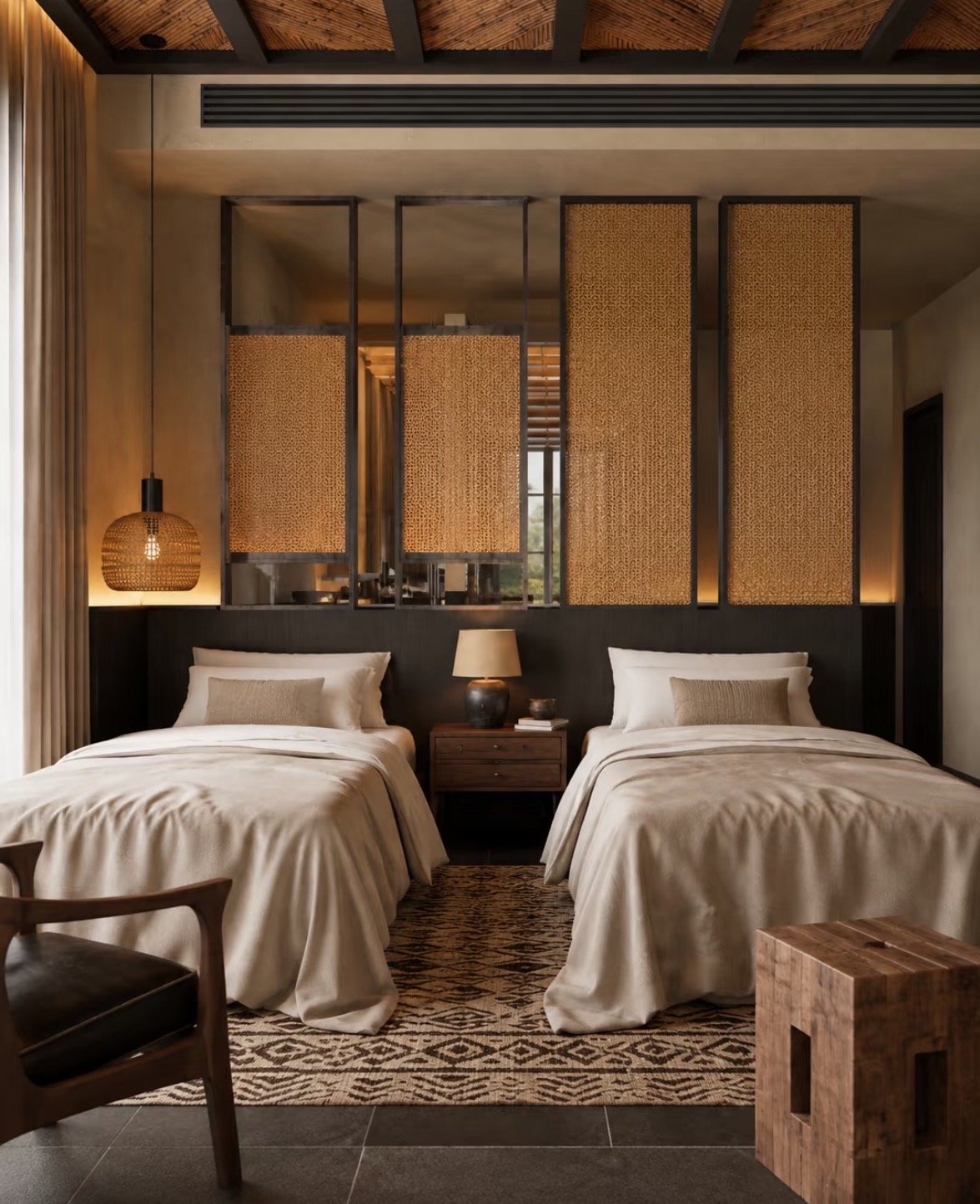
- Bedhead feature wall —the wall panel behind the bed, which may be upholstered, veneered, lacquered or finished in a combination of materials. Often the most design-visible element in the room.
- Writing desk (built-in) —where the desk is fixed to the wall rather than freestanding, it falls under millwork scope.
- Entry console —the shelf or cabinet at the room entrance, typically housing the key card reader, lighting controls and storage.
Bathroom Millwork
The bathroom is the most technically demanding millwork zone in a hotel because of constant moisture exposure. Bathroom millwork covers:
- Vanity unit —the cabinet under the basin, which must be built from moisture-resistant materials (marine plywood for the carcass is standard for hotel bathrooms) and finished to resist cleaning chemicals and water contact.
- Mirror surround and medicine cabinet —framed mirrors, back-lit mirror panels and any concealed storage integrated into the bathroom wall.
- Niche shelving —recessed shelving units built into the shower or bath surround, requiring waterproof substrates and fully sealed finishes.
Public Area and F&B Millwork
Public areas are where the highest-specification and most design-complex millwork lives:
- Reception and concierge desks —typically the centrepiece of the lobby; designed to the architect’s drawings, often incorporating multiple materials (veneer fascia, stone or solid surface top, brass or stainless steel trim).
- Bar counters and back-bar units —the bar front, back-bar cabinetry, speed rail, glass storage and refrigeration housing all fall under millwork scope. Bar tops are often stone or solid surface, supplied separately and coordinated with the millwork carcass.
- Feature walls and panelling —lobby, restaurant and corridor wall panelling in veneer, lacquer, fabric or stone-backed panels.
- Host stands, waiter stations, sommelier cabinets —all the operational millwork that runs a food and beverage operation.
Door Sets
Hotel door sets — guestroom entry doors, connecting doors, fire-rated staircase and service doors, and bathroom doors — are technically part of the millwork scope in most procurement programmes. They are designed to match the room interior, manufactured from the same materials and supplied by the same millwork factory. Door sets carry their own technical requirements: fire ratings (typically FD30 for guestroom doors in most markets) and acoustic performance ratings (typically STC 32–38 for guestroom entry doors against corridor noise).
2. Key Purchasing Considerations for Resort Hotel Millwork
Resort hotels present a set of purchasing challenges that do not apply — or apply less intensely — to city hotels. A resort is typically in a coastal, tropical or island location: high ambient humidity, salt air, UV exposure and remote access all affect the millwork specification and procurement process. Here are the considerations that matter most.
Moisture and Humidity: Specify the Right Substrate for the Location
The substrate — the core panel material inside every millwork item — must match the moisture environment of the location. This is the most consequential specification decision in resort millwork procurement, and it is frequently underspecified on projects sourced by teams unfamiliar with tropical climates.
Standard MDF absorbs moisture and swells. In a Caribbean, Indian Ocean or South-East Asian resort where guestroom humidity can exceed 70% RH during the wet season — even with air conditioning — standard MDF wardrobes and bathroom vanities will delaminate and swell within two to three years. The fix is to specify moisture-resistant substrates: HMR-MDF (a modified resin MDF identifiable by its green cross-section) for damp zones such as minibar cabinets and coffee stations, and marine plywood (manufactured with WBP phenolic glue and a void-free core) for bathroom vanities and any millwork in direct contact with water. For coastal resorts, the safest approach is to specify HMR-MDF as the minimum substrate throughout — not just in wet zones.
Salt Air and Hardware: Specify Marine-Grade Where It Counts
Coastal resort projects also affect hardware. Standard steel hinges, drawer runners and locks corrode quickly in salt air environments. For beachfront and oceanfront properties, specify:
- 316 grade stainless steel for all exposed hardware —316 SS contains molybdenum, which gives it significantly better corrosion resistance than 304 SS in salt-air coastal environments. The difference is visible within 12–18 months of opening at a beachfront property.
- Soft-close drawer runners and hinges in salt-air-rated finishes —Blum and Hettich both produce marine-environment variants of their standard hotel hardware ranges. Confirm the specific product reference with the factory and request the technical datasheet.
Lead Times: Plan Further Ahead Than You Think
Resort hotels are almost always in remote locations, which means shipping takes longer and mistakes are harder to fix on site. By the time a millwork defect is identified during installation at a Caribbean island or Indian Ocean resort, the factory in China is 10,000–14,000 kilometres away and re-making a replacement wardrobe will add six to ten weeks to the opening programme.
The practical consequence is that resort millwork procurement must start earlier and be managed more carefully than urban hotel procurement. Allow at minimum 100–130 days from approved shop drawings to goods on vessel for a full resort millwork programme. Add the ocean transit time (28–42 days to Caribbean or Indian Ocean destinations from a south China port) and destination customs clearance. For a resort targeting a specific opening date, work backwards from that date to establish the latest possible shop drawing approval date — and then start the shop drawing process at least six weeks before that.
Mock-Up: Do Not Skip It for a Remote Resort
A mock-up — a production-equivalent set of room millwork built for review before bulk production begins — costs time (typically 15–20 days) and money, but it is not optional for a remote resort project. The mock-up is the last point at which the finish, substrate, hardware and dimensions can be corrected before 150 rooms’ worth of joinery goes into production. For projects where travelling to the factory in China is not feasible, a video-assisted remote mock-up review — combined with physical sample boards sent by air to the client — is a practical and widely accepted alternative that most experienced millwork factories in China can accommodate.
Consolidation: Millwork and FF&E in One Shipment
For resort hotels procuring both fixed millwork and loose FF&E from China, consolidating both into full container loads is one of the most effective ways to control freight cost. Millwork carcasses are typically flat-packed or knocked-down for export and stack efficiently alongside casegoods, upholstered furniture and accessories. The key is coordination: items from different factories must be ready at the same time, packing must be sequenced to match the site installation order, and the customs documentation must cover everything in the container. An experienced sourcing agent will manage this consolidation process — it is not something to leave to the factories to coordinate between themselves.
3. Why China for Resort Hotel Millwork?
Chinese millwork factories in Guangdong’s Pearl River Delta — particularly in Foshan and the surrounding area — have invested significantly in hotel joinery production over the past two decades. The combination of German CNC routing technology, automated lacquer lines and large veneer pressing facilities allows them to produce complex custom hotel millwork at a cost typically 40–60% below equivalent North American or European millwork shops, with lead times that are competitive when the procurement programme is managed correctly.
The factories with the strongest hotel track records are not the largest factories — they are the ones with dedicated hotel project teams, in-house shop drawing capabilities and experience working with international interior designers and hotel brands. Finding and vetting these factories, managing the shop drawing approval process and coordinating quality inspections is where an experienced sourcing agent adds the most value on a resort millwork programme.
| One-Stop Sourcing for Resort Projects
Many resort developers and operators are looking for a single procurement partner who can manage both fixed millwork and loose FF&E from China — coordinating shop drawings, mock-ups, production schedules, pre-shipment inspections and consolidated freight across all categories. FFE Sourcing China works with resort developers across the Caribbean, Indian Ocean and Europe on exactly this basis: one point of contact, one consolidated shipment, one documentation package. |
| Planning a resort project? Contact FF&E Sourcing China at ffesourcing.com/contact-now |
Frequently Asked Questions
What substrate should be used for hotel millwork in a tropical or coastal resort?
Use moisture-resistant substrates throughout. For dry guestroom areas in climate-controlled rooms, HMR-MDF is the safe minimum for coastal destinations. For bathrooms and any millwork in direct contact with water, specify marine plywood (WBP phenolic glue, void-free core) for the carcass. Avoid standard MDF in tropical resort environments — it swells and delaminates within a few years when ambient humidity is consistently high.
How long does custom hotel millwork take to source from China?
From approved shop drawings to goods on vessel: approximately 75–100 days for a 100–200 room resort. Add 15–20 days for the mock-up phase before bulk production, and allow 4–8 weeks for the shop drawing approval sequence. Total elapsed time from design intent drawings to goods at a Caribbean or Indian Ocean port is typically 5–6 months including ocean transit. The most common cause of delays is slow shop drawing approvals — not production.
Can millwork and loose FF&E be shipped together from China?
Yes — and consolidating millwork and FF&E into full container loads is one of the most effective ways to reduce freight cost per unit. Millwork carcasses are flat-packed or knocked-down for export and consolidate well with casegoods and soft goods. Coordinate packing schedules carefully so that items from different factories are ready at the same time.