
When a hotel developer or interior designer reviews a quote for custom joinery — a reception desk, a guest room wardrobe system, a fitted headboard wall, a restaurant bar — the specification typically covers dimensions, materials, and finishes. What it rarely specifies, but should, is fabrication method: how the individual components are joined together to form the finished unit.
This single decision affects everything that follows: the cleanness of the finished surface, the number of visible fixings and panel holes, the structural integrity of the unit over years of commercial use, the complexity of site installation, and ultimately the gap between what the render promised and what the installation delivered.
There are two fundamentally different approaches to custom fixture fabrication. Understanding the difference is one of the most practically useful things a hotel procurement team or interior designer can know before briefing a factory.
| Who this guide is for Interior designers specifying custom joinery for hotel and commercial projects. Hotel developers and procurement managers evaluating factory quotes. Project managers coordinating FF&E installation on site. Anyone who has received two quotes for the same custom fixture at very different price points and wants to understand why. |
1. The Two Fabrication Methods: What They Are and How They Differ
Custom joinery — whether a hotel wardrobe carcass, a millwork headboard panel, a reception counter, or a restaurant booth — can be fabricated using one of two primary construction methods.
Knock-Down (KD) Construction: the cam lock system
Knock-down construction, also referred to as ready-to-assemble (RTA) construction, is the method used by the majority of volume furniture manufacturers globally. Components are fabricated as individual flat panels and shipped unassembled. They are joined on site using a system of pre-drilled holes and mechanical hardware — most commonly cam lock fasteners (also called confirmat fittings or eccentric connectors) combined with connecting bolts and dowel pins.
The cam lock mechanism works by inserting a connecting bolt into a pre-drilled hole in one panel, and rotating a cam disc housed in a matching hole in the adjacent panel to lock the two pieces together. It is fast to install, requires no specialist tools beyond a screwdriver, and produces a structurally adequate joint for residential and light commercial applications.
For high-volume furniture manufacturers, knock-down construction has clear logistical advantages: components ship flat, take up less container volume, and can be assembled by relatively unskilled labour on site.
Solid-Constructed (Factory Pre-Assembled) Joinery: the professional standard
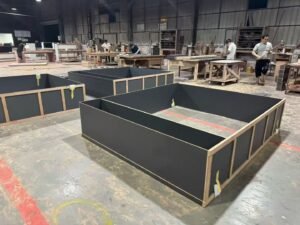
Solid-constructed joinery — also referred to as case-constructed or factory-assembled joinery in the commercial millwork industry — is built as a complete, structurally integrated unit in the factory before it leaves for site. Panels and components are joined using combinations of dado joints, rebate joints, mortise-and-tenon connections, pocket screws with adhesive, and where appropriate biscuit or dowel reinforcement — all secured with structural adhesive for a permanent, rigid bond.
The unit arrives on site as a finished piece. Site work is reduced to positioning, levelling, scribing to wall conditions where required, and connecting adjacent units. There is no on-site assembly of the carcass structure itself.
2. The Visible Difference: Surface Quality and Finish
The most immediately apparent difference between the two fabrication methods is surface appearance — specifically the presence or absence of hardware holes, cam lock recesses, and visible panel joints on finished surfaces.
What cam lock construction leaves behind
Every cam lock joint requires two pre-drilled holes: one in each of the panels being joined. These holes are typically 15–20mm in diameter. On visible surfaces, they are covered with plastic caps — a solution that is functional but impossible to conceal completely, and one that becomes increasingly visible as caps discolour or loosen over years of use in a commercial environment.
Panel joints in knock-down construction are also more visible. Because panels meet at butt joints held together by the hardware alone (rather than housed into a dado or rebate), the junction between panels is typically a straight line that becomes more apparent as the unit flexes slightly in use and the joint opens fractionally.
What solid-constructed joinery looks like instead
In solid-constructed joinery, no mechanical hardware is exposed on finished surfaces. Panels are housed into one another — dados routed into one panel receive the edge of an adjacent panel, rebates create interlocking connections, mortise-and-tenon joints connect frame members with no visible external fixing. Where screws are used, they are counter-sunk below the surface and filled. The structural adhesive forms the primary bond.
The result is a continuous surface with no hardware holes, no plastic caps, no visible panel joints. For hotel environments where the quality of surface finish is part of the guest experience — and where photography of the space will be scrutinised by potential guests — this difference is not a minor detail. It is the difference between a piece that reads as a piece of architecture and one that reads as furniture.
| Knock-Down (Cam Lock) | Solid-Constructed (Factory-Assembled) | |
| Hardware visibility | Cam lock holes + plastic caps on finished surfaces | No exposed hardware on finished surfaces |
| Panel joint visibility | Butt joints, visible line between panels | Housed joints (dado/rebate), seamless junctions |
| Surface continuity | Interrupted by hardware recesses | Continuous, uninterrupted finished surface |
| Long-term finish quality | Caps discolour/loosen; joints open with use | No degradation of joint or surface integrity |
| Suitable for high-end hotel finish | Limited | Yes — professional commercial standard |
3. Structural Integrity: How the Joint Performs Under Commercial Use
Beyond surface appearance, the two fabrication methods produce structurally different units — and the difference matters significantly in commercial hospitality environments where fixtures experience far higher rates of use than residential furniture.
The structural weakness of cam lock systems at scale
A cam lock joint is a mechanical connection only. It holds two panels together through clamping friction — the rotating cam disc grips the head of the connecting bolt and pulls the two panels together. There is no material bond: if the cam disc loosens (which happens with vibration, with repeated use, or simply with time), the joint becomes loose.
For a single wardrobe in a hotel guest room, a cam lock joint that loosens creates a visible gap and a structural unit that moves. For a large wardrobe wall system spanning 3 or 4 metres with multiple vertical dividers, a loose cam lock joint anywhere in the structure can cause the entire carcass to rack — the panels rotate relative to each other, doors go out of square, drawers bind. The repair requires removing the entire unit.
How solid construction handles structural loads
In solid-constructed joinery, the structural bond is the adhesive — which, when properly applied to well-fitted joints, creates a connection that is typically stronger than the wood substrate itself. Dado joints and rebates distribute load across the full width of the panel edge rather than concentrating it at a single hardware point. A properly constructed dado joint cannot loosen: the only failure mode is the wood itself breaking, not the joint opening.
For commercial hotel applications — wardrobe systems that will be opened and closed thousands of times over a 7–10 year FF&E cycle, bar counters that bear significant weight and take repeated impact, reception desks that are leaned on by staff and guests all day — structural permanence is not a luxury specification. It is the minimum required standard.
| Why this matters more in hotel than residential settings A cam lock joint in a residential wardrobe might last 10 years before any perceptible loosening. The same joint in a 4-star hotel guest room wardrobe, opened and closed multiple times daily by guests and housekeeping staff, may show structural movement within 2–3 years. Maintenance and refurbishment costs over a fixture’s service life are rarely factored into the original procurement budget — but they should be. |
4. Factory Pre-Assembly: What It Means for Site Installation
One of the most significant practical advantages of solid-constructed joinery is not visible in the finished product at all. It is felt entirely during installation — and its value is most apparent to the people managing a hotel opening timeline.
Installation by design, not by improvisation
In our factory, installation is not an afterthought that happens when the unit arrives on site. It is considered at the design stage. Before a single component is cut, we work through how each unit will enter the building (lift dimensions, door openings, stair widths), how it will be positioned and levelled in the room, how adjacent units will be connected, and what the scribing requirements will be where units meet walls or ceilings with imperfect tolerances.
Units are pre-assembled in the factory specifically to test and confirm this. Each unit is fully built, checked for square, checked for level, and signed off against the approved shop drawing before it is disassembled for packaging and shipping. When it arrives on site, it goes back together in the same configuration it was approved in the factory — there is no on-site problem-solving required because the on-site conditions have already been anticipated.
The factory pre-assembly advantage in numbers
For a hotel project with, say, 60 identical guest room wardrobe units, the time difference between installing knock-down cam lock units and installing solid-constructed factory pre-assembled units is significant:
- Knock-down installation: each unit assembled on site from flat panels using hardware, typically requiring 2–3 hours per unit for a two-person team. For 60 units: 120–180 man-hours of site labour.
- Factory pre-assembled installation: each unit positioned, levelled, and connected as a complete piece, typically 45–90 minutes per unit. For 60 units: 45–90 man-hours of site labour.
The labour cost difference alone is significant. On a hotel opening timeline where every day of site delay costs money, the time difference is material.
| Our pre-assembly process Every unit we fabricate is fully assembled in our Foshan factory before packaging. We verify dimensions against the approved shop drawing, check all doors and drawers for operation, confirm finish quality across the complete unit (not just individual panels), and photograph the assembled unit as part of our pre-shipment documentation. The unit is then carefully disassembled, each component labelled, packed to export standard, and shipped. On site, reassembly follows a numbered sequence that mirrors the factory assembly exactly. |
5. Custom Joinery from China: What to Specify and What to Ask
For hotel developers and designers sourcing custom joinery from Guangdong — the world’s most productive furniture and millwork manufacturing region — the fabrication method question is one that must be asked explicitly, because the default at most factories is knock-down construction.
The volume economics of the Chinese furniture export market have been built on knock-down construction: flat panels ship efficiently, labour for on-site assembly is transferred to the destination country, and the factory’s cost per unit is lower. For mass-market furniture this makes sense. For custom hotel joinery it is the wrong solution.
Questions to ask when briefing a Chinese joinery factory
- How are the carcass joints constructed? The answer should specify the joint type — dado, rebate, mortise-and-tenon, pocket screw with adhesive. “Cam lock” or “confirmat fittings” tells you it is knock-down construction.
- Is the unit factory pre-assembled before shipping? A quality factory pre-assembles every unit, signs it off, and then packs it for shipping. If the unit is shipped as flat panels only, it is KD construction regardless of how the joint type is described.
- What adhesive is used and where? Structural PVA or urea-formaldehyde adhesive applied to dado and rebate joints is the mark of solid construction. No adhesive means no permanent bond.
- Can we see the shop drawing before production begins? A factory that produces proper shop drawings — showing joint types, hardware specifications, assembly sequence — is operating at a professional commercial millwork standard.
- What does your pre-shipment inspection process cover? For solid-constructed joinery, pre-shipment inspection should include the fully assembled unit, not just individual panels. If the factory only inspects components, the assembled unit quality is unverified.
6. What We Fabricate: Custom Hotel Joinery from Foshan
Our factory in Foshan — China’s most established furniture and custom millwork manufacturing centre — specialises exclusively in solid-constructed, factory pre-assembled custom joinery for hotel, resort, and commercial projects. Knock-down cam lock construction is not part of our production process.
Every unit we produce is designed with installation in mind from the first shop drawing. We work through access constraints, connecting sequences, and on-site tolerances at the design stage — not on site. The result is a unit that installs cleanly, finishes cleanly, and performs at a commercial hospitality standard for the full duration of its service life.
Product categories we fabricate
- Guest room wardrobe and luggage systems — single and double-door wardrobes, integrated safe compartments, luggage benches with carcass bases
- Fitted headboard wall systems — full-width upholstered and joinery headboard panels with integrated bedside shelving and lighting pockets
- Vanity and bathroom millwork — vanity carcasses, mirror cabinets, open shelving, bathroom furniture
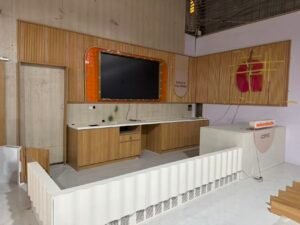
- Reception and lobby joinery — reception desks, concierge counters, lobby credenzas
- Food and beverage millwork — bar back units, banquette booth frames, service station millwork
- Retail and display fixtures — custom display units, shopfitting joinery, point-of-sale counters
Frequently Asked Questions
What is the price difference between solid-constructed and knock-down joinery?
Solid-constructed joinery typically costs 15–35% more per unit than equivalent knock-down construction, depending on joint complexity, substrate specification, and unit size. However, the total cost comparison should include site labour (significantly higher for knock-down installation), long-term maintenance costs (higher for cam lock systems as joints loosen), and the cost of remediation if finish quality falls short of the design intent. For hotel projects where the fixture’s service life is 7–10 years, solid construction is typically the lower total cost option over the full lifecycle.
Can solid-constructed units ship in standard containers?
Yes, with careful packaging design. Pre-assembled units are larger than flat-packed panels, which requires more container volume per unit — typically 20–40% more cubic metres than the equivalent KD unit. For international hotel projects, this should be factored into the logistics budget from the outset. For many projects, the on-site labour saving more than offsets the additional freight cost. Our team works through container loading at the shop drawing stage so there are no freight surprises.
What substrates do you use for hotel joinery carcasses?
Substrate selection depends on the application and the destination environment. For standard guest room joinery in temperate or moderate humidity environments, moisture-resistant MDF (MR-MDF) with a minimum density of 750kg/m³ is our standard carcass substrate. For coastal or high-humidity resort environments — Caribbean, Southeast Asia, Pacific islands — we specify moisture-resistant particleboard or marine-grade plywood for carcass construction, with solid timber or aluminium substrate options for door frames and components most exposed to humidity. We confirm substrate specification with the client before shop drawing production.
Do you supply shop drawings before production begins?
Yes, and this is a non-negotiable part of our process. We produce a full shop drawing package for every project — showing plan, section, and elevation of each unit, joint types and construction details, substrate and finish specifications, hardware schedules, and assembly sequence notes. The shop drawing is submitted for client approval before any cutting begins. Production starts only from an approved, signed-off shop drawing. This is the document that protects both the client and our factory throughout production.
What finish options are available?
For carcass exteriors, we work with high-pressure laminate (HPL), melamine paper in a full range of wood grains and solids, veneer in engineered and natural species, and two-pack polyurethane paint finishes (matt, satin, and gloss). For solid timber components and door frames, we offer factory-applied stain and lacquer to approved colour references. All finish samples are submitted and approved before production, and retained as the production reference throughout the run.
The Specification Decision That Most Briefs Leave Out
Fabrication method is the specification decision that most hotel joinery briefs omit entirely — and it is the one that most determines whether a custom fixture delivers what the render promised. The difference between solid-constructed factory pre-assembled joinery and knock-down cam lock construction is not a matter of preference. It is a matter of quality standard.
For hotel and resort projects where custom joinery is a significant part of the design intent and a significant part of the capital budget, specifying fabrication method explicitly — and verifying it with a factory visit or pre-shipment inspection that covers fully assembled units — is the single most valuable technical decision a procurement team can make before placing an order.
FFE Sourcing China works with our partner factory in Foshan to source and manage custom joinery for hotel projects delivered globally. Every project starts with a shop drawing review. Every unit is factory pre-assembled before shipping. Every delivery is covered by a pre-shipment inspection that includes the fully assembled unit, not just individual components.
| Specify your custom joinery project: ffesourcing.com |