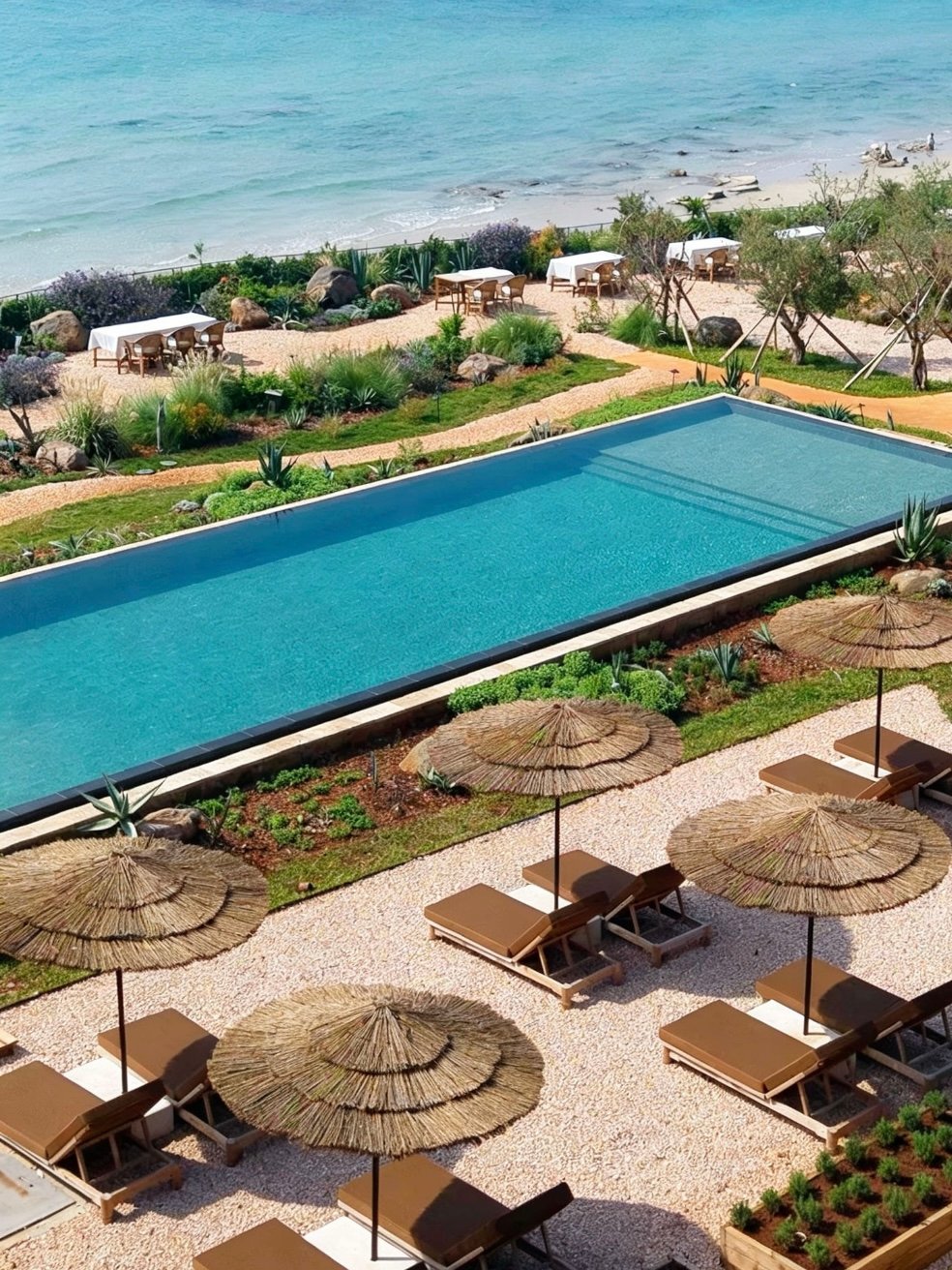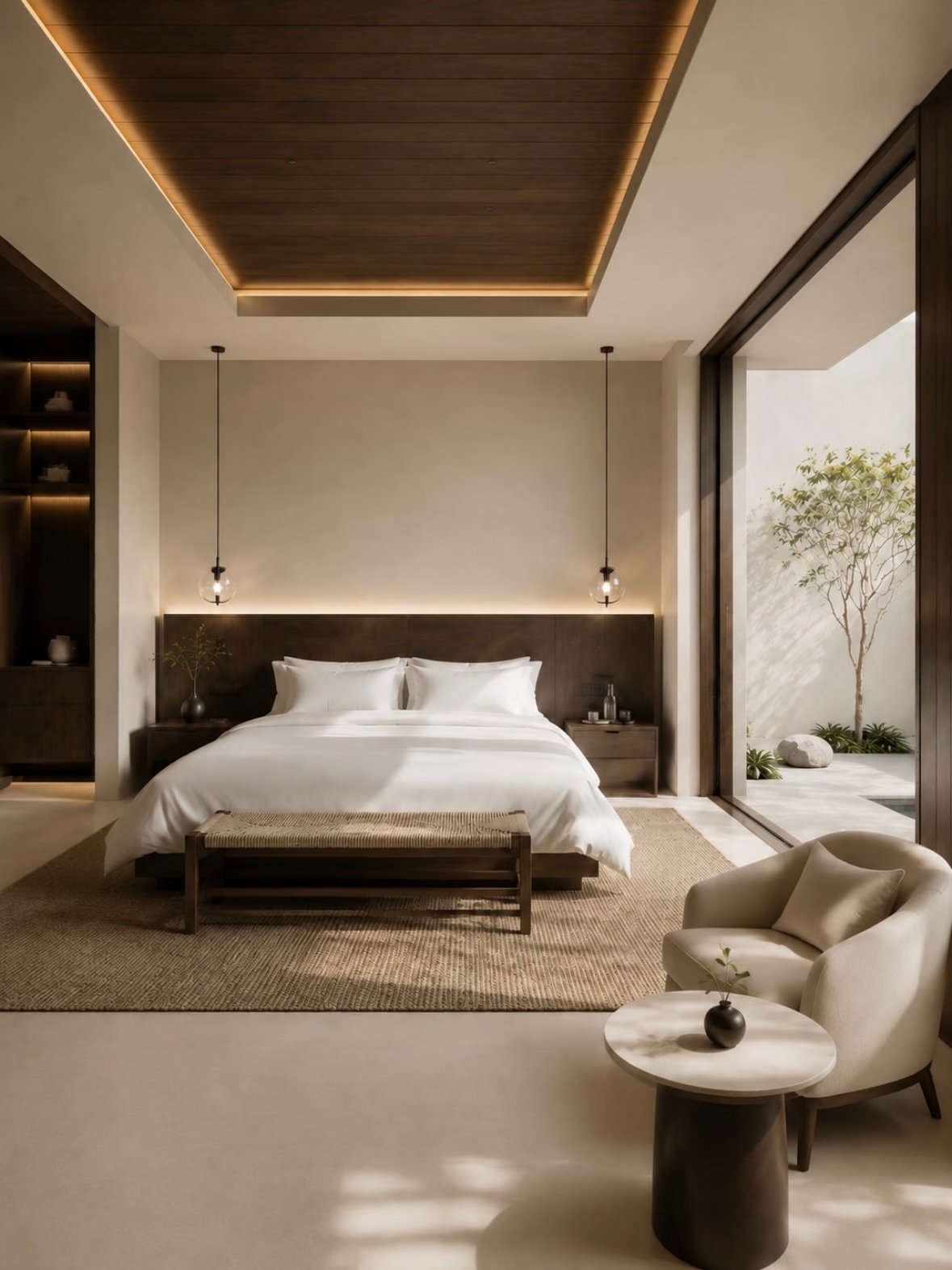

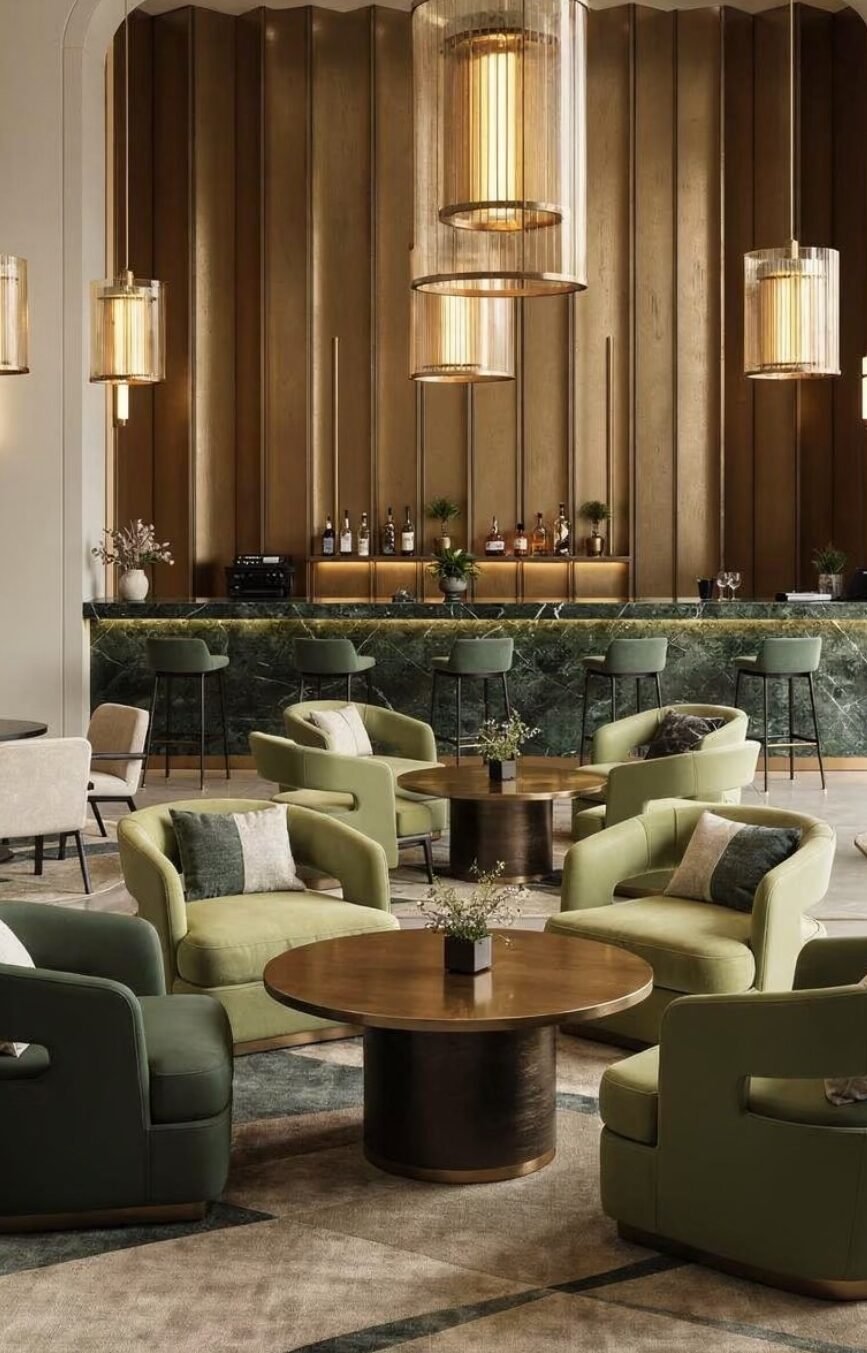
From lobby seating to cabaret theatre chairs — a complete guide to hotel public area FF&E categories, what makes each one different from residential furniture, and how to source them correctly from China.
What you will learn in this guide:
- The 4 core hotel public area FF&E categories and what to specify in each
- Why the cabaret chair is the most misspecified item in hotel entertainment venues
- The exact difference between a cabaret chair and an auditorium chair
- What certification and foam density specs to put in your factory brief
We had a client call us six weeks before their hotel opening. The entertainment venue chairs had arrived. They were bolted together in fixed rows of ten — auditorium chairs, not cabaret chairs. The entire order was wrong. The venue had to open without seating.This happens more often than the industry admits. It is the highest-volume item, the most standardised specification, and the easiest to brief. But it is the public area furniture — the lobby, restaurant, bar, banquet hall, and entertainment venue pieces — that most often causes procurement delays, specification errors, and on-site installation problems.
Hotel public area FF&E operates entirely differently from guest room furniture when it comes to procurement. The two are worlds apart in every critical aspect that shapes sourcing and project delivery.
Public spaces feature a far wider range of product categories. Their furniture also faces tougher daily usage conditions. Unlike standardized guest room pieces, public area items have inconsistent specification benchmarks and require significantly more customisation.
Most importantly, specification errors carry far greater stakes. A mismatched chair or sofa in a hotel bar or entertainment venue is immediately noticeable to guests. It also costs vastly more to rectify than a faulty nightstand hidden inside a private guest room.
This guide covers the four core categories of hotel public area FF&E, explains what to specify in each, and addresses one category that causes a disproportionate number of specification errors — the cabaret theatre chair — which is routinely confused with traditional auditorium seating with costly results.
| Who this guide is for
Hotel owners and resort developers specifying public area furniture for a new build or renovation. Interior designers managing FF&E procurement for hotel projects. Procurement managers who need to brief a China sourcing agent on public area furniture requirements. Anyone who has received a quote for hotel public area FF&E and is not sure what they are actually ordering. |
1. Why Hotel Public Area FF&E Is Different From Guest Room Furniture
Hotel public area furniture operates under conditions that residential furniture — and even much commercial furniture — is not designed for. Understanding these conditions is the starting point for any successful specification.
Usage intensity
A hotel lobby sofa may gets sat on by 80 guests a day. A restaurant chair in a busy hotel F&B operation may go through 10 or more seatings per day across a 365-day year. Bar stools in a hotel bar may be occupied continuously across a 14-hour service period. These usage rates are an order of magnitude higher than residential furniture and significantly higher than typical office or commercial furniture — and the durability specification needs to reflect this.
Scene complexity
Hotel guest rooms have one function — accommodation. Hotel public areas serve multiple, often conflicting functions in the same physical space: a banquet hall that also serves as a conference room and a wedding venue; an entertainment lounge that runs F&B service during a show; a lobby area that transitions between a reception space and an informal working environment across the day. Furniture for these spaces needs to support multiple configurations, which affects specification decisions around weight, stackability, modularity, and material durability.
Design visibility
Public area furniture defines the guest’s first impression of a property. The lobby sofa is what guests see when they walk in. The restaurant chairs are what every guest sits in for every meal. The bar seating is photographed constantly by guests and appears in every review platform image. The specification standard — finish quality, material grade, custom craftsmanship — needs to match or exceed the property’s brand positioning in a way that guest room furniture, which is seen by fewer people for less time, does not always require.
2. The Four Core Categories of Hotel Public Area FF&E
[Image: hotel lobby furniture China factory direct procurement Guangdong]
Category 1: Lobby and Reception Furniture
The lobby is the first physical brand touchpoint for every arriving guest. Lobby and reception furniture needs to communicate the property’s positioning immediately — whether that is grand luxury, relaxed boutique, or contemporary commercial.
Core items in this category include:
- Reception desk: A custom-built unit that is typically the largest single custom millwork piece in the hotel. Material options range from marble-topped solid timber carcasses at the luxury end to high-quality laminate and engineered stone at the upper-midscale level. Reception desks are almost always custom-made to the specific hotel’s floor plan and brand standards — you won’t find it in a catalogue.
- Lobby lounge seating: Sofas, armchairs, and lounge chairs for the hotel’s arrival and waiting areas. For high-traffic hotel lobbies, upholstery specification is critical — fabric grade, foam density (35–50kg/m³ for contract lounge seating, with 40–50kg/m³ recommended for high-traffic hotel lobbies), and structural frame construction all affect the piece’s service life under commercial use.
- Coffee tables and side tables: Often custom to match the sofa and chair specifications. Material choices should consider ease of cleaning and resistance to the wear patterns of commercial use.
- Decorative cabinetry and display units: Feature display cabinets, credenzas, and storage units that contribute to the lobby’s aesthetic. These are typically custom millwork items.
- Waiting and queue seating: Functional seating at reception and concierge points. Often specified separately from lounge seating with a focus on durability and ease of cleaning over aesthetic character.
| Lobby furniture sourcing from China
Lobby lounge furniture — sofas and armchairs specifically — sourced from Guangdong’s Foshan manufacturing district offers the most significant cost advantage over European and North American alternatives. Contract-grade upholstered lounge seating that meets commercial durability standards (Martindale abrasion resistance minimum 40,000 rubs for lobby seating fabric — 60,000–100,000 rubs recommended for high-traffic lobby environments — foam density 40–50kg/m³) is readily available from specialist factories in Foshan’s Shunde and Longjiang districts. |
Category 2: Restaurant and Banquet Hall Furniture
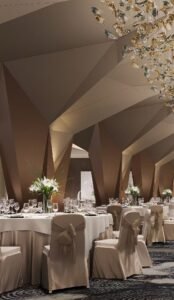
Hotel restaurant and banquet furniture operates under the most demanding conditions of any hotel public area — high turnover, constant cleaning, temperature and humidity variation from food service, and the need to accommodate multiple configurations across the same week. The specification priorities are durability, cleanability, and flexibility.
Core items include:
- Dining chairs: The highest-volume and most specification-sensitive item in this category. Key parameters are: frame material (solid wood vs metal — metal is significantly more durable for high-turnover restaurant use), seat foam density (minimum 38kg/m³ for restaurant dining, with 45kg/m³ recommended for high-turnover environments), fabric specification (contract-grade with minimum 40,000 Martindale rubs for restaurant dining, 60,000+ rubs for high-turnover or banquet environments, with stain resistance treatment), and stackability (critical for large banquet halls that re-set between events).
- Dining tables: Size, base material, and tabletop specification vary significantly by venue type. Restaurant dining tables require high-pressure laminate (HPL) or solid surface tops that resist heat, moisture, and cleaning chemicals. Banquet tables are typically folding or modular to allow rapid re-configuration.
- Banquet folding chairs: A specific sub-category for large-volume banquet operations. Banquet chairs need to stack efficiently (typically 8 to 12 chairs per stack), have a robust frame (powder-coated steel is standard), and be light enough for banquet operations staff to handle and transport in volume.
- Restaurant side furniture: Service stations, buffet counters, host stands, and wine storage units — typically custom millwork items that need to integrate with the kitchen and service workflow.
| The most common specification error in restaurant furniture
Specifying residential-grade dining chairs for a hotel restaurant. Residential dining chairs use foam densities of 20 to 28kg/m³, fabrics with Martindale ratings below 15,000 rubs, and structural joints designed for occasional residential use. Under hotel restaurant conditions — multiple seatings per day, daily cleaning with commercial products, guests using chairs in ways they would not at home — residential chairs typically fail structurally within 12 to 18 months. Always specify commercial contract grade explicitly in the factory brief. |
Category 3: Bar and Lounge Seating
Hotel bar, rooftop lounge, poolside, and lobby bar seating combines the aesthetic requirements of a designed hospitality space with the durability requirements of high-turnover commercial use. This category also frequently extends to outdoor environments — pool decks, terraces, and rooftop bars — where material specification needs to address weather resistance, UV stability, and salt-air corrosion for coastal properties.
Core items include:
- Bar stools: Available in fixed-height and height-adjustable (gas lift) versions. For hotel bars, footrest durability is a critical specification point — footrest bars take continuous wear from guests resting and scraping their feet, and cheap powder-coat or paint finishes fail quickly. Specify brushed stainless steel or anodised aluminium footrests for high-use hotel bars.
- Lounge chairs and single seating: The individual armchair and occasional chair category for hotel bars and lobby bars. Upholstery specification mirrors lobby seating in terms of fabric grade and foam density.
- Banquette and booth seating: Fixed-position upholstered seating along walls and in booth configurations. Frame construction is typically timber or MDF on a steel sub-frame, upholstered in commercial-grade fabric or leather. The key specification issue is foam resilience — banquette seating that loses its shape within two years of installation is one of the most common hotel F&B furniture failures.
- Outdoor and poolside furniture: Requires weather-resistant frame materials (powder-coated aluminium, marine-grade stainless steel, or teak), UV-stable synthetic fabrics or quick-dry cushion inserts, and for coastal properties, anti-corrosion treatment on all metal components. Jiangmen district in Guangdong Province specialises in anti-corrosion materials for exactly this application.
3. The Most Misspecified Item in Hotel Public Area FF&E: The Cabaret Chair
Of all the specification errors that occur in hotel public area FF&E procurement, the most consistently costly is the confusion between cabaret theatre chairs and traditional auditorium or theatre chairs. The two products look superficially similar in a catalogue image. They are fundamentally different products designed for completely different applications — and ordering the wrong one for a hotel entertainment venue typically means either unusable furniture or an expensive re-order.
We have seen this mistake made by procurement teams at properties that absolutely knew better. The catalogue image looks similar enough. The price is similar. The mistake is not caught until the container is opened.
What is a cabaret chair?
A cabaret chair (also called a cabaret theatre chair or entertainment venue chair) is a purpose-designed, freestanding, stackable upholstered chair for hotel entertainment venues, performance dining restaurants, showroom bars, and multi-purpose event spaces.
The defining characteristics that make it specifically suited to hotel entertainment venues are:
- Freestanding and mobile: A cabaret chair has no floor fixing. It is a self-contained single chair that can be moved, repositioned, and reconfigured without any tools or structural modification to the venue. This is the defining functional requirement for hotel entertainment spaces that need to transition between a dining setup, a performance configuration, a reception layout, and a private event format — sometimes multiple times per week.
- Stackable for storage: Designed to stack efficiently — typically 6 to 10 chairs per stack — for compact storage during daytime operations or when the venue is re-configured for a different event type. This stackability is only possible because of the specific structural design of the frame, which differs significantly from both residential armchairs and fixed auditorium seating.
- Upholstered seat and back: Provides the comfort level appropriate for guests who may be seated through a 90-minute to 2-hour performance, dining simultaneously. Standard specification is padded seat and padded back, with upholstery in commercial-grade fabric or faux leather, and a frame in either solid timber or powder-coated metal.
- Dining and viewing combined: The proportions and seat height are specifically designed to work with a small side table or cabaret table (typically 600mm diameter round at seated height) so that guests can dine while watching a performance. Standard dining chairs are not designed for this configuration.
Cabaret chair vs auditorium chair — the critical comparison
The single most important distinction for procurement purposes is between a cabaret chair and a traditional theatre or auditorium chair. Many procurement teams and less experienced designers conflate the two because both are used in entertainment and performance environments. They are completely different products.
| Cabaret Chair | Traditional Auditorium / Theatre Chair | |
| Floor fixing | None — fully freestanding | Fixed to floor, cannot be moved |
| Configuration | Individual single chair | Linked in rows — cannot be separated |
| Stackable? | Yes — 6 to 10 chairs per stack | No — not designed for stacking or storage |
| Dining compatible? | Yes — designed for dining + viewing | No — no table configuration possible |
| Re-configuration | Full flexibility — minutes to rearrange | Permanent — cannot be changed without structural work |
| Suitable for hotel? | Yes — designed specifically for hotel use | No — designed for fixed-seat venues only |
| Installation required? | None — place and use | Permanent floor fixing by specialist installer |
| Used in | Hotel entertainment lounges, showrooms, performance dining | Theatres, cinemas, conference halls, lecture halls |
| Minimum order consideration | Flexible — can be ordered in exact quantity | Typically row-based minimums |
| The cost of ordering the wrong chair
A hotel that orders traditional auditorium chairs for its entertainment venue instead of cabaret chairs discovers the error when the chairs arrive fixed in linked rows that cannot be separated, cannot be stored, and cannot be reconfigured for any other event format. The venue becomes a fixed-seat cinema — not the flexible entertainment and dining space the operator needs. You will be re-ordering. Full stop. Specify cabaret chairs explicitly and verify the supplier understands the difference before placing the order. |
What to specify when ordering cabaret chairs from China
When briefing a Chinese furniture factory on cabaret chairs, the following specifications are the critical parameters:
- Frame material: Solid timber (typically beech or rubberwood) or powder-coated steel. Solid timber frames are lighter and warmer in aesthetic; steel frames are more durable for very high-use venues. Specify the material and finish explicitly.
- Seat foam density: Minimum 38kg/m³ for commercial entertainment use, with 45kg/m³ recommended for high-frequency venues. Lower densities compress permanently within 12 to 18 months under regular use.
- Upholstery material: Commercial-grade fabric (minimum 40,000 Martindale rubs for entertainment venue use) or commercial faux leather. Specify the exact material reference — do not leave this to the factory’s discretion.
- Stacking capacity: Confirm the number of chairs per stack with the factory and verify this with a physical sample test before full production. Stacking capacity depends on the specific structural design and cannot be assumed from catalogue images.
- Armrest option: Available with or without armrests. Armrest models are more comfortable for longer performances but take more storage space per stack. Specify based on your venue’s event profile.
4. Procurement Rules for Hotel Public Area FF&E
Hotel public area furniture is fundamentally different from residential or general commercial furniture procurement in three ways that affect every aspect of the sourcing process.
Everything is custom — there is no standard catalogue
Unlike guest room casegoods — where a standard wardrobe dimension of 900mm wide × 600mm deep × 2100mm high is consistent across thousands of hotel rooms globally — hotel public area furniture is almost entirely custom. The lobby sofa dimensions are determined by the specific lobby floor plan and the designer’s intent. The restaurant chairs are specified to match the restaurant’s colour palette and material scheme. The bar stools are selected to complement the bar counter height and the overall F&B aesthetic.
So, public area FF&E procurement cannot be handled by browsing a factory’s standard product range and selecting from existing models. Every significant item needs to be custom-specified, and that specification needs to be documented in a factory brief that covers dimensions, materials, finishes, foam specifications, hardware, and upholstery — before any production quote is issued.
Sample sign-off is non-negotiable
For all upholstered public area pieces and all custom millwork items, a physical sample must be produced, reviewed, and formally signed off before mass production begins. The sample process typically takes 3 to 5 weeks for furniture and 4 to 8 weeks for complex custom millwork — this needs to be built into the procurement timeline, not treated as an optional extra.
The signed-off sample becomes the gold standard reference for the pre-shipment inspection. Without a signed-off sample, there is no objective basis for quality assessment at the inspection stage — the inspector is comparing finished goods against their own judgement rather than an agreed standard.
Container planning for public area furniture
Public area furniture — particularly large lobby sofas, banquette frames, and custom millwork pieces — is typically bulkier per piece than guest room casegoods. This affects container loading efficiency. A 40-foot high-cube container that carries a full complement of guest room wardrobe units may carry significantly fewer lobby lounge pieces by volume — large sofas and sectional seating occupy 3 to 5 times the cubic metres of a standard wardrobe unit.
For hotel projects sourcing both guest room and public area furniture from Guangdong, consolidating all items — across multiple factories and product categories — into the minimum number of containers is one of the most significant logistics cost levers available. A specialist sourcing agent managing the full project scope can coordinate this consolidation; buyers managing direct relationships with multiple factories typically cannot.
5. Why Guangdong Is the Right Source for Hotel Public Area FF&E
The Guangdong manufacturing corridor — specifically Foshan’s Shunde and Longjiang districts for upholstered furniture, and the broader Pearl River Delta for specialist categories — produces the full range of hotel public area furniture at price points that are consistently 30 to 50 percent below equivalent European and North American contract manufacturers.
More importantly for hotel public area FF&E specifically, Guangdong’s manufacturing base has deep experience with the customisation demands of hospitality projects. The factories that produce hotel public area furniture in Foshan work from designer specifications and shop drawings as standard practice — not from a catalogue. They have experience with the material grades, construction standards, and finish quality levels required for 4- and 5-star hotel projects.
For buyers in the US, Caribbean, UK, and Canada — FFE Sourcing China’s primary markets — the combination of Guangdong’s manufacturing depth, the cost advantage over Western alternatives, and the ability to consolidate all public area and guest room items into a single managed shipment makes China sourcing the correct procurement decision for the vast majority of hotel public area FF&E categories.
Frequently Asked Questions
What is included in hotel public area FF&E?
Hotel public area FF&E covers all furniture, fixtures, and equipment in the hotel’s public-facing spaces outside of guest rooms. This includes lobby and reception furniture (reception desk, lounge seating, coffee tables), restaurant and banquet furniture (dining chairs and tables, banquet chairs, side furniture), bar and lounge seating (bar stools, lounge chairs, banquette seating), and entertainment venue seating (cabaret chairs, feature seating for performance spaces). It also includes outdoor and pool deck furniture for resort properties.
What is the difference between a cabaret chair and a regular dining chair?
A cabaret chair is specifically designed for hotel entertainment venues where guests need to both dine and watch a performance. It is proportioned to work with a small cabaret side table at the correct height for simultaneous dining and viewing, it is stackable for storage when the venue re-configures between events, and it is freestanding for maximum layout flexibility. A regular dining chair is designed for a fixed dining position at a standard table height and is not typically designed for the same stacking capacity or multi-function use.
How long does hotel public area FF&E procurement from China take?
For hotel public area FF&E projects, the full timeline from initial specification to destination port delivery is typically 5 to 8 months — longer than guest room casegoods because of the higher custom content and more complex sample sign-off process. Custom millwork pieces (reception desk, banquette frames, built-in millwork) have the longest lead times — typically 10 to 16 weeks for production after sample sign-off. For hotel projects with a fixed opening date, public area FF&E procurement should start at least 6 months before the required on-site delivery date, with 8 months recommended for projects with significant custom elements.
Can hotel public area furniture and guest room furniture be shipped in the same container?
Yes — and container consolidation is one of the most significant logistics cost efficiencies available for hotel projects sourcing from China. FFE Sourcing China consolidates all items across multiple factories and product categories — guest room casegoods, public area furniture, building materials, and custom millwork — at a single Guangdong consolidation point, minimising the number of containers required for the full project shipment. This typically saves 15 to 25 percent of logistics costs compared to managing separate shipments from multiple factories.
What certifications should hotel public area furniture from China have?
Certification requirements vary by destination market. For UK hotel projects, upholstered furniture must comply with BS 7176 (medium hazard) and pass the BS 5852 Crib 5 ignition test for the complete upholstery composite. For US hotel projects, composite wood components must meet CARB Phase 2 formaldehyde emission standards. For all markets, commercial contract-grade fabric for hotel public areas should have a Martindale abrasion rating of minimum 40,000 rubs — 60,000 rubs or above for restaurant, bar, and lobby seating in high-traffic environments. Request documentation for all applicable certifications before production sign-off — not at the port.
The Public Area Makes the First Impression
Hotel public area FF&E is what guests experience before they ever reach their room. The lobby sofa, the restaurant chair, the bar stool, and the entertainment venue seating define the guest’s first physical impression of a property — and that impression is hard to recover from if the furniture fails to deliver on the property’s positioning.
The lobby sofa is the first thing a guest sits on. The restaurant chair is what they return to for every meal. The bar stool is what ends up in every Instagram photo.None of these are places to cut specification corners.If you are sourcing hotel public area FF&E from China and want a frank assessment of your specification — whether it will hold up, whether the factory brief is complete, whether the timeline works — get in touch. We will tell you what we think.
FFE Sourcing China sources hotel public area FF&E across all categories — lobby, restaurant, bar, entertainment venue, and outdoor — from our verified factory network across Foshan, Dongguan, and Guangdong. Every project starts with a thorough specification review. Every custom item is sampled and signed off before production. Every shipment is inspected before loading. Contact us for a free assessment of your hotel public area FF&E requirements.
| Request a free hotel FF&E consultation: ffesourcing.com/contact |