The Procurement Manager's Guide to High-End Cabinetry Sourcing from China
Eight technical specifications that prevent the most common high-end cabinetry sourcing problems from China — carcass colour matching, appliance integration, shop drawing errors, hardware specs, and more.
FF&E SOLUTIONSPROCUREMENT SERVICES
Eight technical specifications that separate a flawless kitchen installation from a costly on-site problem — from a team that has managed both.
Who this guide is for
Interior designers and procurement managers specifying custom cabinetry for hotel projects, commercial fit-outs, and high-end residential developments. Project managers who have sourced cabinetry from China before and encountered installation problems — or who want to avoid encountering them for the first time.
1. The Carcass Colour Trap
This is the most common oversight in overseas cabinetry procurement, and it is entirely avoidable.
Carcasses — the interior structural boxes of cabinets — are white melamine by default. The problem is that there are dozens of different whites. Bright white. Warm white. Off-white. Cool white. They look similar under factory lighting in China. They look obviously different side by side in a completed kitchen.
For projects where any carcass surface is visible — open shelving, glass-front units, island end panels, or any exposed end carcass — specifying "white melamine" is not sufficient. You must specify the exact white reference. And if your door panels are a specific warm white, your carcass interior must match it.
5. Substrate Specification: What Is Inside the Cabinet Matters
Cabinet finish quality is what designers specify. Cabinet substrate quality is what determines how the finished product performs over its service life — and it is what many procurement briefs fail to specify at all.
Core material grade
E1-grade MDF or E1-grade particleboard is the standard specification for low-emission composite wood in cabinetry for hotel and commercial applications. For any project destined for the US market, CARB Phase 2 compliance is mandatory — specify it explicitly, and require the factory to provide the certification documentation with the shipment, not after.
For kitchens and bathrooms where moisture exposure is a factor — hotel restaurant back-of-house, laundry rooms, bathroom vanities — specify moisture-resistant (MR) grade board rather than standard grade. The price difference is minimal. The performance difference in a high-humidity environment is significant.
Back panel thickness
Standard back panels on cabinetry produced for residential markets are often 3 to 5 millimetres — adequate for a domestic kitchen used by one household. Hotel and commercial cabinetry is subject to heavier use, more frequent cleaning, and a higher expectation of structural rigidity. Specify back panel thickness of 9 millimetres minimum for any commercial application. This dimension is almost never called out in design specifications, and almost always defaults to the minimum if not specified.
6. Delivery and Packing for Cabinetry
Cabinetry is among the most packing-intensive products to ship from China to global destinations. The combination of large flat surfaces, painted or veneered finishes, and protruding elements — door handles, drawer fronts, moulding profiles — creates multiple damage vectors during ocean transit.
The minimum packing standard we specify for high-end cabinetry:
• Painted or veneered door faces: interleaved with foam sheet and packed face-to-face, not face-to-back.
• Leading edges and corners: foam-wrapped or corner-carded before boxing. Leading edge damage is the most common visible transit defect on painted cabinetry.
• Carcass units: individually shrink-wrapped then boxed. Units packed in stacks need interlayer foam to prevent surface contact damage from vibration.
• Hardware: packed separately in labelled bags and boxes keyed to the item they belong to. Hardware arriving in a single unlabelled bag requires the installation team to sort and identify every fitting before a door can be hung.
• Filler panels and mouldings: bundled, labelled by location (e.g. "island end panel left" not "filler 1"), and packed to prevent edge damage.
The packing specification should be part of the factory brief, reviewed at the pre-shipment inspection, and documented with photographs before the container is sealed.
7. Pre-Shipment Inspection for Cabinetry: What to Check
Standard pre-shipment inspection practice applies here: visual quality check against the gold standard sample, dimensional check against the shop drawings, hardware function test, and packing assessment. For cabinetry specifically, add these checks:
• Carcass interior colour match: compare against the specified interior reference panel under controlled lighting, not factory floor lighting.
• Door swing and hinge adjustment: open and close every door in the inspection sample set. Hinges that are not properly adjusted will not be adjusted on arrival — and hinge adjustment on-site across a 50-unit kitchen project is a full day of additional labour.
• Drawer runner operation: extend every drawer in the sample set to full extension and release. Soft-close mechanism should engage consistently. Drawer boxes should run smoothly without lateral movement.
• Filler panel and moulding quantities: count against the delivery schedule. Missing fillers or mouldings are not discoverable until installation begins.
• Touch-up kit inclusion: confirm present and labelled before loading.
8. The Technical Interface Between Your Design Team and the Factory
The most expensive cabinetry sourcing problems are not factory quality failures. They are specification failures — designs that were not fully resolved before the factory brief was issued, or factory briefs that did not accurately translate the design intent.
This interface — between what a designer intends and what a factory brief instructs — is where a professional sourcing agent adds the most specific value in cabinetry procurement. Not just as a buyer's representative, but as a technical translator who understands both the design language of a specification document and the manufacturing language of a factory brief.
The specific contributions this role makes:
• Specification gap review: identifying missing dimensions, unspecified materials, and ambiguous instructions before the factory is briefed — not after the first sample arrives.
• Shop drawing review: a second-pass review of all shop drawings before production approval, specifically checking for mirroring errors, filler panel dimensions, and hinge orientation.
• Mandarin-language factory communication: all technical instructions communicated in Mandarin directly to the factory. The specification drift that occurs when technical requirements pass through parties unfamiliar with the manufacturing context is eliminated.
• On-site production monitoring: physical visits during production to confirm materials match specification, finish quality is consistent, and back panel thickness and substrate grade are as specified — not substituted.

Planning a hotel or commercial cabinetry project? Request a free consultation: ffesourcing.com/contact
Frequently Asked Questions
Can I source cabinetry and hotel furniture in the same container?
Yes — and this is the most cost-efficient approach. We manage cabinetry and furniture FF&E through the same procurement process and consolidate everything into a single container shipment where possible. Combined procurement also ensures material consistency across the full project: veneer species, finish systems, and hardware finishes can be specified to match across cabinet and furniture items.
What certifications should hotel cabinetry from China carry?
For US market projects: CARB Phase 2 for all composite wood substrates — mandatory for market entry. For UK projects: confirm formaldehyde emissions class (E1 or E0 grade) and any specific certification required by your project brand standard. For the Caribbean: requirements vary by territory — confirm with your local building control or brand standard representative at the specification stage.
How long does custom cabinetry from China take?
Standard custom kitchen cabinetry: 6 to 10 weeks from approved shop drawings to production completion. Complex bespoke projects with non-standard substrates, specialist finishes, or integrated appliance features: 8 to 14 weeks. Add 3 to 5 weeks for sampling and shop drawing sign-off before production begins. Ocean transit to destination port: 20 to 35 days depending on destination. We recommend beginning cabinetry procurement in parallel with furniture FF&E — not after furniture is confirmed.
What happens if units arrive damaged or incorrect?
Prevention at origin is the correct approach: a thorough pre-shipment inspection, export-grade packing, and marine cargo insurance. If damage does occur on arrival, having the exact paint touch-up kit and oversized filler panels already on site allows minor defects to be resolved by the installation team. For structural damage or incorrect units, the most expedient resolution is replacement production — which requires a spare parts order with the factory at the time of the main order, not after the problem is discovered.
High-End Cabinetry from China: The Standard It Can Achieve
Chinese manufacturing — when correctly specified, properly audited, and professionally managed — can produce cabinetry that matches or exceeds the quality of European alternatives at a fraction of the cost. The gap between a successful high-end cabinetry project and a problematic one is not the factory. It is the specification, the technical management, and the quality control process.
FF&E Sourcing China manages cabinetry procurement from initial specification review through shop drawing approval, production monitoring, pre-shipment inspection, and consolidated container shipping. If you are planning a hotel, resort, or commercial cabinetry project, contact us for a free project consultation.
Planning a hotel or commercial cabinetry project? Request a free consultation: ffesourcing.com/contact
Sourcing cabinetry from China is a proven strategy for delivering high-end kitchen results at significantly lower cost than European or North American alternatives. Done correctly, it works extremely well. Done without the right technical controls, it produces the kind of problems that cannot be resolved on-site — a white melamine interior that does not match the door panels, a refrigerator that will not sit flush, a full run of units that has been mirrored the wrong way.
These are not hypothetical scenarios. They are the specific, recoverable — and sometimes unrecoverable — mistakes that happen when cabinetry procurement is treated as a standard furniture order. It is not. Cabinetry is an integrated architectural component. Every dimension interfaces with something else: the appliance, the wall, the floor level, the adjacent run. A single specification error, multiplied across a full kitchen package, creates a problem that cannot be hidden.
After managing multiple medium-to-high-end cabinetry projects sourced from Guangdong Province, we have compiled the technical controls that consistently prevent those problems. This guide covers eight of them — drawn directly from real project experience, not sourcing theory.
The pro specification
For any project with visible carcass surfaces, specify exterior-grade matching panels for all exposed end carcasses and interior-visible surfaces. Provide a physical colour reference panel to the factory — not a digital swatch, which renders differently across screens and print outputs. Retain a copy of the reference panel as part of your gold standard sample set.
2. Appliance Integration: Never Assume Standard Sizes
The single most common appliance-related cabinetry problem is depth. Standard cabinet depths are designed around standard appliance depths — and standard appliance depths vary by manufacturer, model, and market.
Refrigerator depth
Always obtain the exact installed depth specification for the refrigerator — including handles and any rear clearance requirements — before finalising cabinet depths. A refrigerator that protrudes 50 millimetres beyond the cabinet run is not a flush finish. For hotel projects where the kitchen is part of a designed interior, this matters significantly. The cabinetry depth must be specified to achieve the flush or recessed position the design requires.
Undermount sink faucet clearance
Undermount sinks create a clearance challenge that is invisible on a flat drawing but immediately apparent on installation. The faucet body mounts through the worktop from above. The supply hoses and valve bodies hang below. The cabinet door behind the sink must be able to open and close without contacting the faucet body or the supply connections.
The clearance dimension — from the back of the sink basin to the inside face of the cabinet door in the closed position — must be verified for every specific combination of sink model and faucet model before the shop drawing is issued. This is a measurement the factory cannot make without the sink and faucet specifications. Provide them.
3. Shop Drawings Are the Contract — Treat Them That Way
For any cabinetry project above a single small kitchen, shop drawings are not a courtesy document. They are the contractual specification to which all production is held and against which all delivery is checked.
A shop drawing reviewed casually and approved quickly is a risk carried through to installation. The two most common shop drawing errors we have encountered in practice:
Mirrored units
Cabinetry units have a handed orientation — a left-hand door hinge position and a right-hand door hinge position are different products. When reviewing a shop drawing that shows multiple kitchen runs, it is easy to approve a unit as correctly specified without noticing that the hinge side has been drawn in mirror image of the intended design.
The mitigation is deliberate: on every shop drawing review, consciously verify the hinge position and swing direction of every door. Not as an assumption from the overall run view — as an explicit check on each individual unit. Mark the approved hinge position on the physical sample. If the sample is correct and the shop drawing matches the sample, proceed.
The site-adjustment buffer
No construction site matches its drawings perfectly. Wall faces are not perfectly plumb. Floor levels vary. The gap between the end of a cabinet run and a wall face will not be exactly the filler panel dimension shown on the drawing.
Always specify filler panels at 10 to 20 millimetres larger than the drawn dimension. This gives the on-site installation team material to scribe and cut, which is fast and invisible. Filler panels that are too small cannot be extended. The alternative to a scribing buffer is a visible gap — or a remedial order from China with a 10-week lead time.
4. Hardware Specification: Two Details That Affect Every Installation
Specify quick-disconnect hinges
Quick-disconnect hinges — also called clip-on or tool-free hinges — allow cabinet doors to be detached and reattached without tools by releasing a simple lever or clip mechanism. The alternative is traditional screw-fixed hinges that require the door to be unscrewed from the mounting plate for any adjustment.
For hotel and commercial cabinetry installations, where a single project may involve hundreds of doors, the installation time difference is significant. Quick-disconnect hinges also simplify the inevitable on-site adjustments and any future maintenance access. Specify them explicitly in the hardware schedule — do not assume they are standard. In many Chinese factories, traditional hinges are the default unless quick-disconnect is called out.
Require factory-matched paint touch-up kits
Painted cabinet finishes will sustain minor damage during ocean transit, unloading, and on-site installation — regardless of how well they are packed. Scratches to leading edges, paint chips from packing material contact, and small abrasions from adjacent units shifting in the container are all routine occurrences.
The only correct on-site response is a touch-up with the exact paint formulation used in production. A generic paint match from a local hardware supplier will not achieve a satisfactory result on a high-end painted finish — the sheen level, the tint, and the paint system type all affect the result.
Require the factory to supply a labelled touch-up kit — paint, clear coat if applicable, and a fine brush — for every project. This is a minor cost at factory stage and an indispensable resource on site. Build it into the contract as a delivery requirement, not a request.
Request a free cabinetry project consultation: ffesourcing.com/contact
Why Cabinetry Sourcing Is Different from Furniture Procurement
Most of what applies to hotel furniture procurement applies here — factory vetting, sample sign-off, pre-shipment inspection, and container consolidation are all equally important for cabinetry. But cabinetry has a set of additional technical requirements that furniture does not.
The reason is integration. A hotel armchair, delivered one centimetre narrower than specified, is a nuisance. A run of kitchen cabinets delivered one centimetre narrower than specified can mean the appliances will not fit, the worktop will not land correctly, and the end-of-run filler panels are the wrong size. The same dimensional error has a fundamentally different consequence.
Cabinetry also has more components than furniture. A single kitchen package for a hotel project may include carcasses, doors, drawers, internal fittings, plinths, cornice mouldings, filler panels, end panels, and associated hardware — all of which must arrive correctly, in the right quantities, and in undamaged condition. The factory brief must account for all of them. A brief that specifies the door finish and ignores the carcass interior is incomplete.
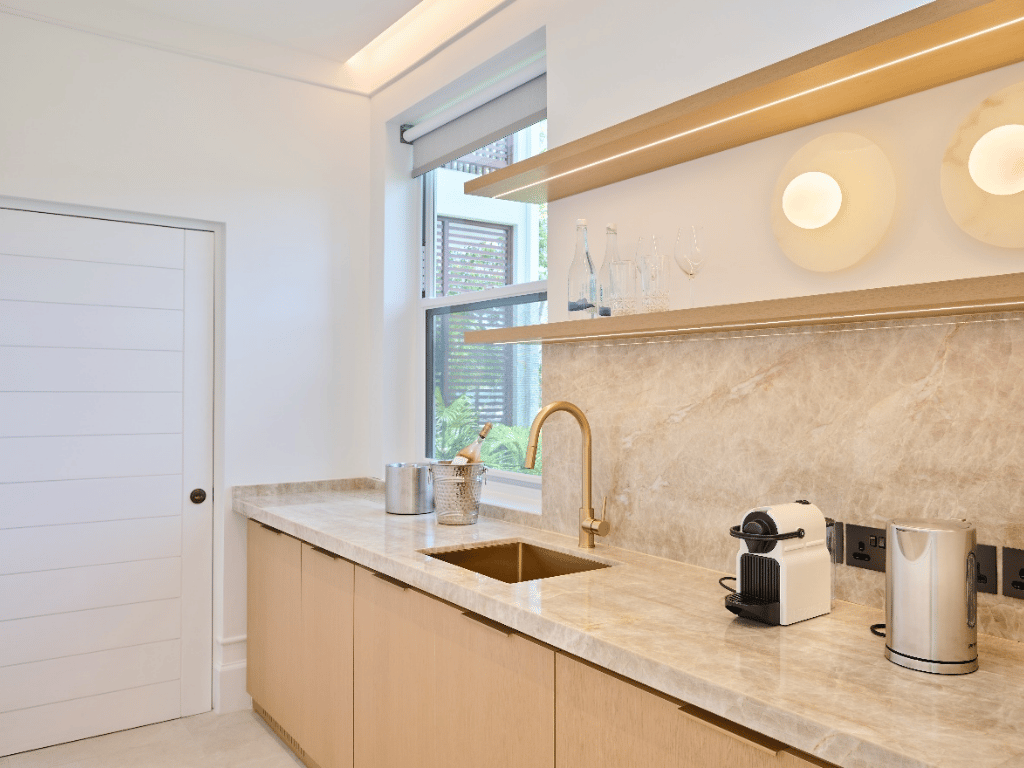
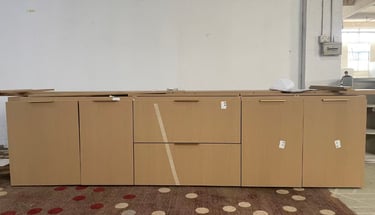
high-end kitchen cabinetry hotel project China sourcing-AFTER
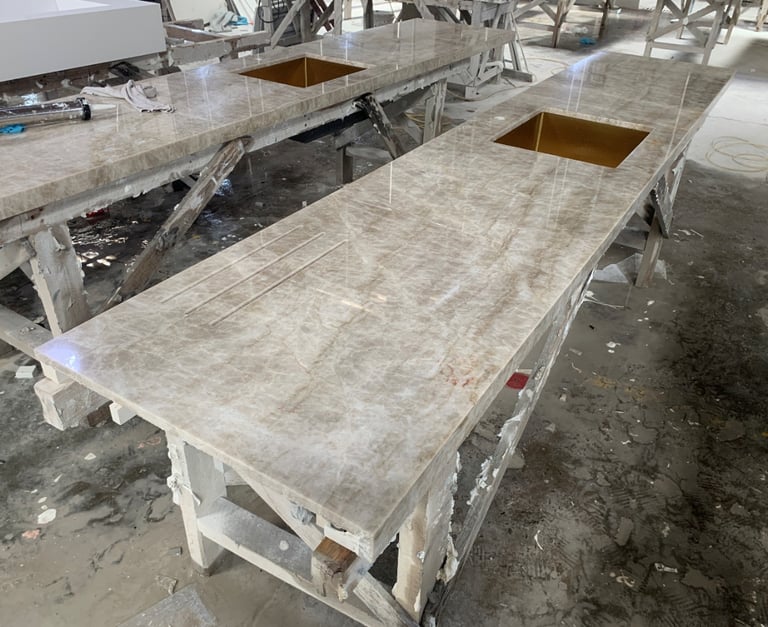
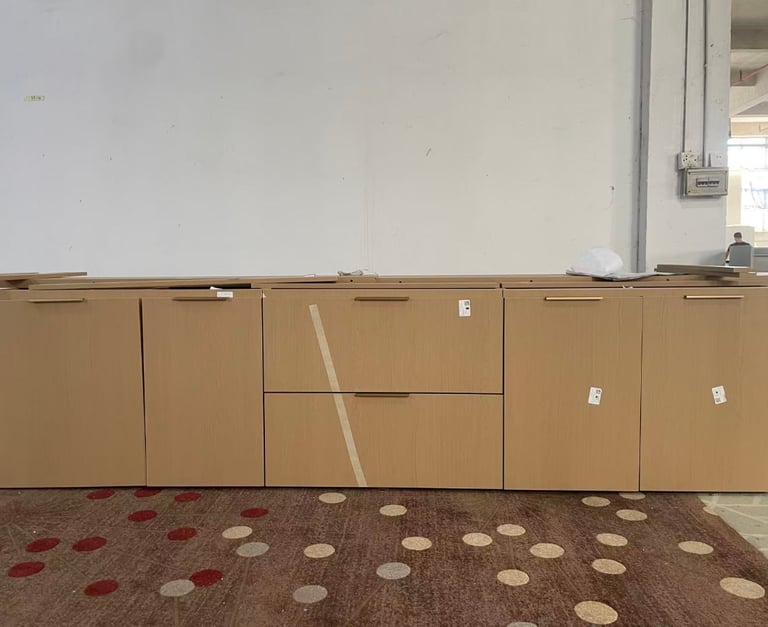
high-end kitchen cabinetry hotel project China sourcing-BEFORE
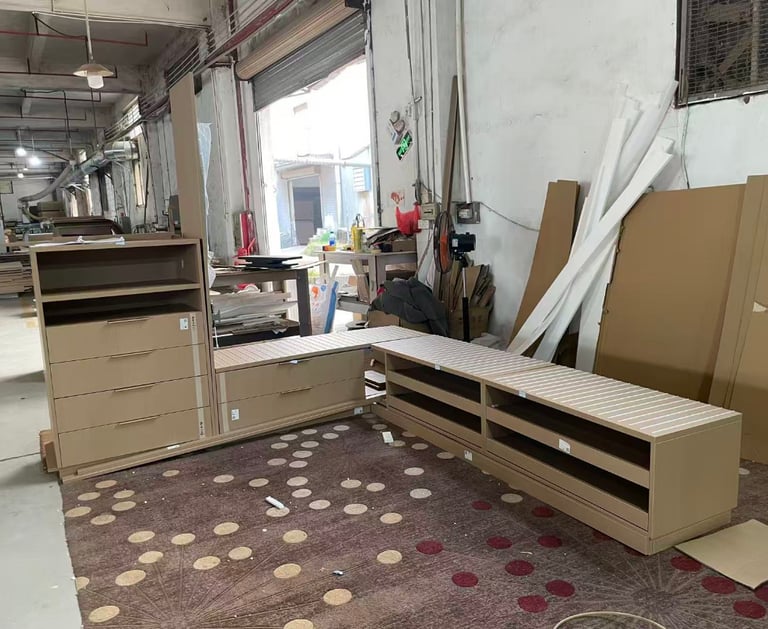
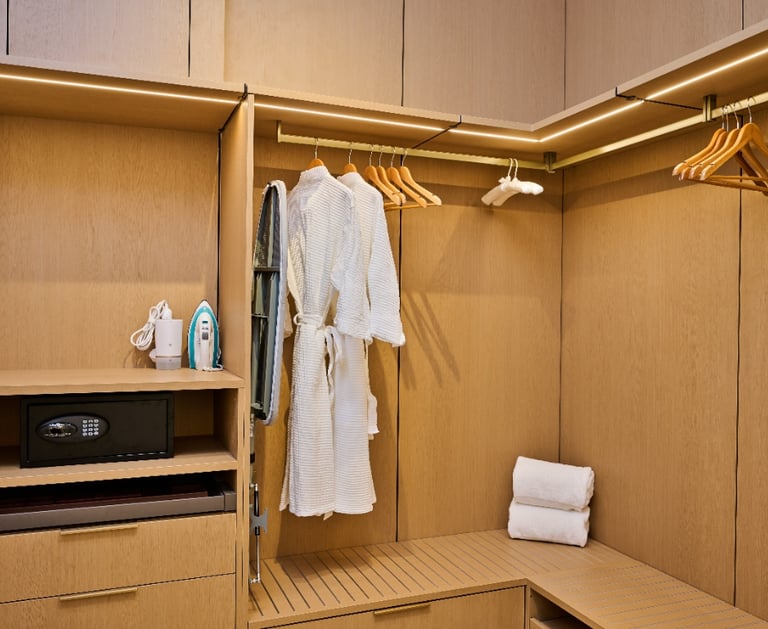

high-end cabinetry hotel project China sourcing-BEFORE v.s AFTER
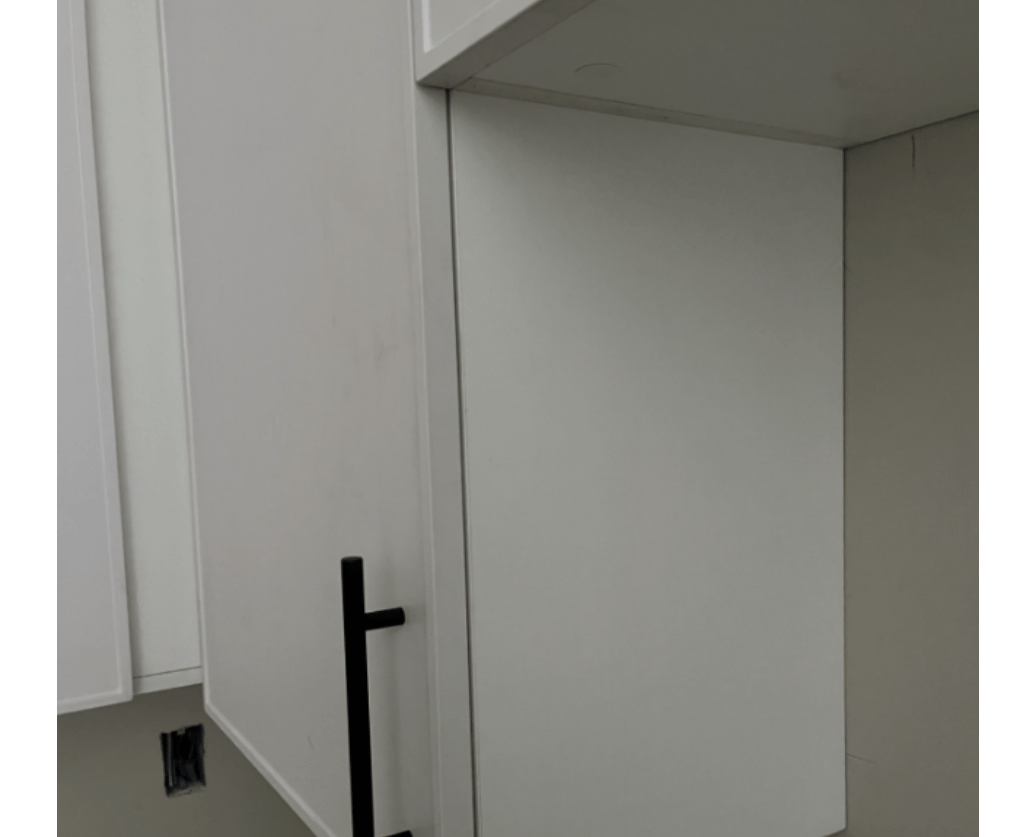
Color mismatch between cabinet carcass and doors
Company Links
+86 18138789304
© 2026. All rights reserved.
Contact
Our Services
Custom Furniture&Millwork Service
Quality Management
Furniture Sourcing Trips
About FF&E Sourcing
We are a China sourcing agent based in Guangzhou, specializing in global hotel, resort, and commercial projects. With over 30 years of experience, we source all your project needs directly from verified factories.